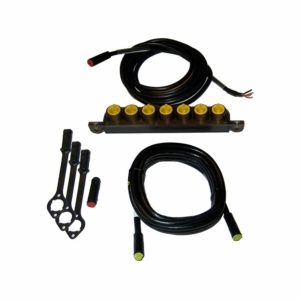
Fig.: SimNet connection technology
SimNet is a bus system for boats from Simrad, which is based on the CAN bus and has limited compatibility with NMEA2000, comparable to Raymarine's SeaTalk NG. With SimNet, Simrad also relies on proprietary connection technology that is only compatible with Simrad products. Physically, 5-pin connectors are used as in NMEA2000, but in a different format.… Continue reading
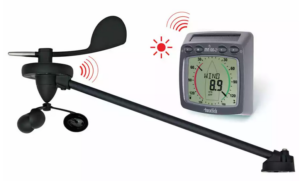
Fig.: Masttop transducer T120 (Raymarine)
MicroNet is a wireless sensor data transmission method supported by some Raymarine sensors and displays, such as the T120 masthead wind transducer and the Log + Echosounder system in conjunction with the Marine TackTick T100 display. Raymarine also offers a gateway called Micro-Talk that can convert data from the wireless MicroNet to SeaTalk NG.… Continue reading
Raymarine SeaTalk NG
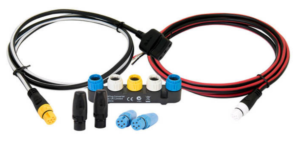
Fig.: SeaTalk NG connection technology
With SeaTalk NG there is a more powerful successor to SeaTalk, which is based on the CAN bus and has limited compatibility with NMEA2000. With the fairly clear and color-coded connection technology of SeaTalk NG, Raymarine has managed to provide backwards compatibility with SeaTalk, which also supports older devices. The disadvantage, however, is the high price for the proprietary connection technology.… Continue reading
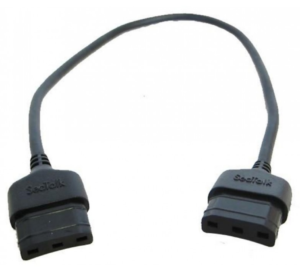
Fig.: SeaTalk connection technology
SeaTalk is a Raymarine proprietary serial network protocol developed in the 1980's and used for the transmission of navigation data and other information on boats. The data is transmitted as compact binary data. SeaTalk uses a single wire connection as the data line for serial data transmission, meaning they are both sent and received bit by bit over a single wire.… Continue reading
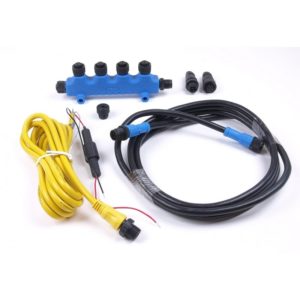
Fig.: NMEA2000 connection technology (Busse yacht shop)
NMEA2000 (National Marine Electronics Association 2000) is a bus system for communication in boats. It was designed to provide a uniform interface for transferring data from electronic devices on boats.
operating principle
NMEA2000 is a bus system designed to transmit data between electronic devices on boats.… Continue reading
First of all, a few important notes that you should definitely pay attention to.
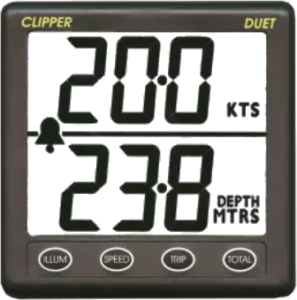
Fig.: NASA/Clipper Duet Sonar/Log
This article is about how to convert a NASA/Clipper Duet echo sounder/log so that the device outputs NMEA2000 data. This document is based on the DIY project by Sönke and was supplemented with some additional information. The NASA/Clipper Duet echo sounder/log is actually a device without a bus connection and works independently with two separate sensors.… Continue reading
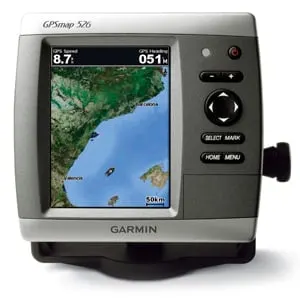
Garmin GPSmap526 (Garmin)
Garmin is one of the few commercial manufacturers that also allow the use of public free maps on their devices. This makes it possible to also provide older devices with up-to-date map material when support has expired. Garmin offers a variety of navigation devices that can be used on-road for street navigation as well as off-road for tracking.… Continue reading